West of Scotland
Rot and woodworm treatment in Glasgow
Surveys and treatment for dry rot, wet rot and woodworm across Glasgow and the West, from Ayrshire up to Stirling. Somebody looks at the timber before anybody puts a price on it.
- We look before we priceNo quote without a survey
- Written reportSomething a lender will accept
- West of Scotland onlyGlasgow to Ayr and Stirling
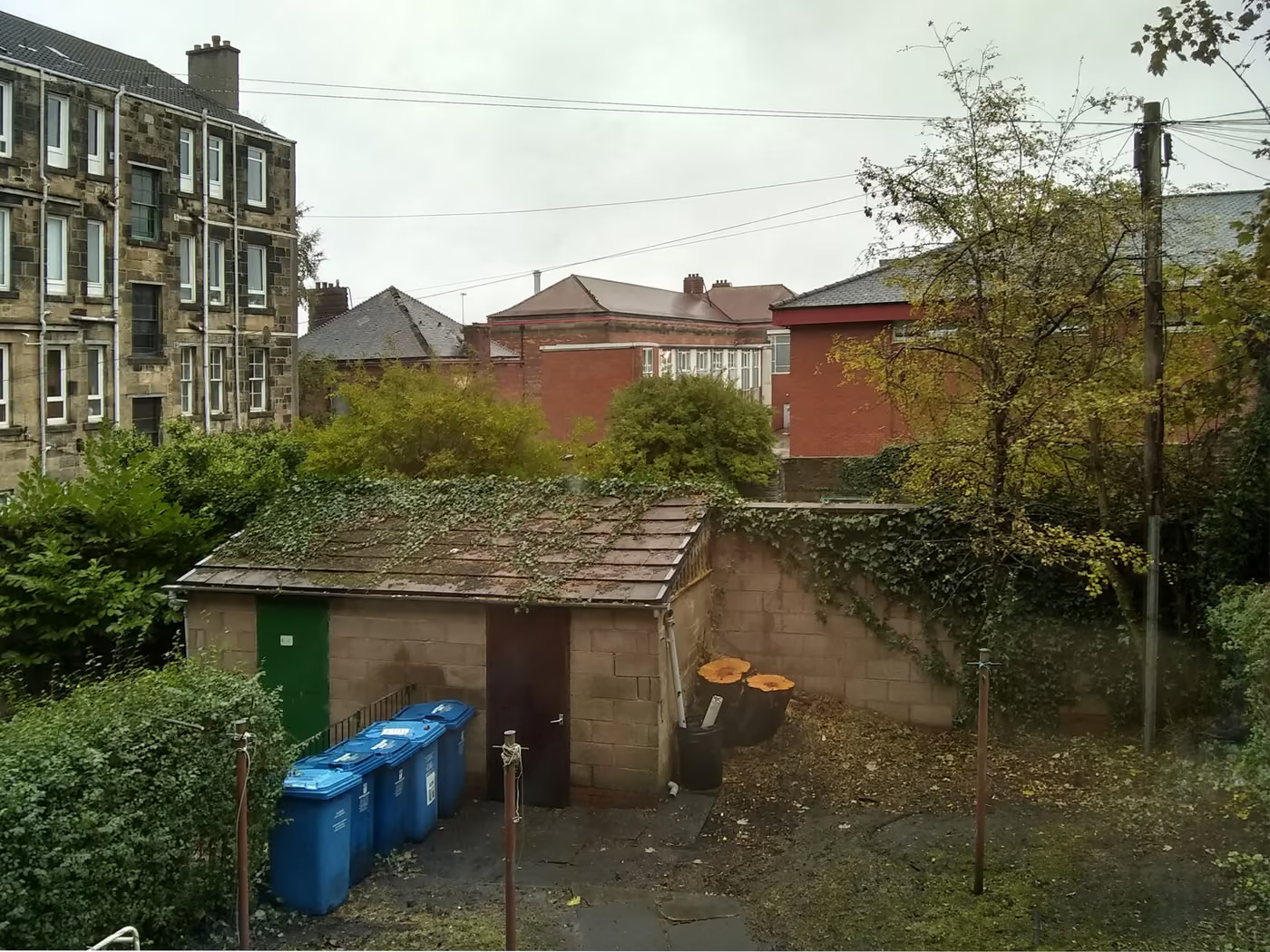
The West is where most of this site's rot enquiries come from, and that is not a quirk of who happens to find us. Greater Glasgow holds an enormous quantity of pre-1919 sandstone tenement, sitting under the wettest weather in the Central Belt, with roofs and rainwater goods that belong to everybody in the building and therefore, in practice, often to nobody. Put those three facts together and you have the conditions this trade exists for.
This page is the starting point for the West. It covers what the area actually is in building terms, because "Glasgow" is a poor description of a region that runs from Victorian tenements in Dennistoun to nineteen sixties council-built stock in East Kilbride, and it says where the team travels. If you already know which of the three problems you are looking at, the pages below go straight into what each one does to buildings here.
Book a survey
Three questions. You do not need to know which problem you have.
One region, several completely different building types
The reason a West of Scotland surveyor cannot work from a script is that the next four addresses on the list will be four different centuries of construction, each of which fails in its own way.
Sandstone tenements
The West End, Dennistoun, Partick, Govanhill, Shawlands, Pollokshields and most of Paisley's older core. Solid sandstone walls, no cavity and no damp proof course, with the ends of the timber floor joists built directly into the stone. There is nothing between the joist end and the wall, so anything that wets that wall wets the timber inside it. Add shared gutters and downpipes that no single owner is responsible for and you have the classic West of Scotland dry rot job.
Interwar and post-war semis and villas
Bearsden, Milngavie, Bishopbriggs, Newlands, large parts of Rutherglen and the outer edges of Paisley and Kilmarnock. Cavity walls start appearing here, which helps, but the ground floors are still suspended timber over a ventilated void, and that void is only ventilated for as long as the airbricks are clear. Roughcast render on these houses hides the point where water is getting in, so the first sign is usually inside rather than out.
Post-war council-built housing, now largely private
East Kilbride, Cumbernauld, Castlemilk, Drumchapel, and swathes of Motherwell, Airdrie and Coatbridge. Much of this stock was bought under right to buy and is now sixty or seventy years old in private hands, which means it is reaching the age where flat roofs, low-pitch roofs and non-traditional construction start to leak. Timber content varies enormously between one building type and the next, so what we find here is far less predictable than in a tenement.
New build and recent conversions
Not immune, just different. Woodworm is rare because the timber is treated before it arrives on site. Wet rot around a badly detailed balcony, a leaking shower tray or a flat roof upstand is not rare at all, and neither is decay in a converted mill or warehouse where old timber was kept and built into a new envelope that traps moisture against it.
How far the West actually goes
The team covers Glasgow itself, Renfrewshire, Dunbartonshire, Lanarkshire, Ayrshire and Stirling. In practice that means Paisley, Renfrew, Erskine, Johnstone and Barrhead to the west, Clydebank, Dumbarton and Helensburgh down the river, Bearsden, Milngavie, Bishopbriggs, Kirkintilloch and Cumbernauld to the north, Coatbridge, Airdrie, Motherwell, Hamilton, East Kilbride, Rutherglen and Cambuslang to the east and south, and Kilmarnock, Ayr and Stirling at the far edges.
The East of Scotland is a separate team with a separate patch, so if your property is in Edinburgh, the Lothians, Fife or the Borders you want that half of the site rather than this one. We would rather tell you that now than take an enquiry we cannot serve.
Areas with their own page
Some parts of the West are different enough from the city that the general advice above stops being much use. These have been written up separately:
- Lanarkshire, where the stock is mostly twentieth century and the drains have been moved by old workings.
- Renfrewshire, which takes the weather off the estuary before anywhere else does.
- Paisley, the largest concentration of pre-1919 property in the West outside Glasgow.
- East Kilbride, a new town with almost none of the construction this page has been describing.
- Motherwell, with Wishaw and Bellshill, where past damp work and retrofit cause a good deal of what we find.
- Coatbridge and Airdrie, low ground, cellars, and woodworm that is really a moisture problem.
The three problems, and where each one turns up here
- Dry rot is the one that travels, and in Glasgow it is overwhelmingly a tenement problem: failed rainwater goods, wallhead gutters, bay window structures and the close itself.
- Wet rot is commoner and usually cheaper, and here it lives under suspended ground floors where the airbricks stopped working years ago.
- Woodworm shows up in tenement floor voids and roof spaces, and turns up constantly in the high turnover rental stock of the West End and Southside.
If you cannot tell which you have, that is normal and it is not something to apologise for. Start withthe difference between wet rot and dry rot, or book a timber survey that covers all three in one visit.
A good share of what we are called to in the West is historic.Old woodworm holes with nothing living in them, or a patch of soft timber left over from a leak somebody fixed in the nineties, are extremely common findings. Establishing that costs a survey and saves the treatment, and it is a far better outcome than being sold a floor treatment you did not need. It is also why we will not price anything from a photograph, in either direction.
How an enquiry works
- You tell us what you are looking at. The form takes three questions and "I am not sure" is a perfectly good answer to the one about which problem it is.
- A survey is arranged. Somebody comes out, opens up enough to see what is actually happening, and works out where the water is coming from rather than just where the damage shows.
- You get it in writing. What was found, what caused it, and what putting it right involves, in a form a lender or a factor will accept.
- Then, and only then, a price. If the honest answer is that the timber is sound and nothing needs doing, that is what the report will say.
The shared repair problem, in one paragraph
It deserves stating up front because it catches out almost every first time tenement owner in the West. The thing causing your rot is frequently a gutter, a hopper, a downpipe or a roof that is common property under Scottish tenement law, which means the repair is not yours alone to commission and the cost is split across the flats in the building. That changes the timeline more than it changes the technical work. TheGlasgow dry rot page goes into what that means in practice, including what you can do while the shared side is still being argued about.
Questions we get from the West
The damage is in the close, not inside my flat. Is that still my problem?
Partly, yes. In a Scottish tenement the close, the roof, the gutters and the downpipes are usually common property shared between the owners, so a repair there is a shared repair rather than one owner’s job. That changes who decides and who pays, and it usually slows things down. It does not change the fact that the water is currently getting into timber, and the longer that runs the bigger the eventual bill for everybody in the building.
Do you actually cover Ayrshire and Stirling, or is it really just Glasgow?
The West team covers the whole area, and a fair share of the work is outside the city. Paisley, Johnstone and Renfrew are routine. So are Motherwell, Hamilton, Airdrie, Coatbridge and East Kilbride. Ayr, Kilmarnock, Stirling, Dumbarton and Helensburgh sit at the edges of the patch and get visited less often, so the wait for a survey slot there can be longer. If you are further out than that, say so when you enquire rather than after.
Is timber decay genuinely worse in the West than the East of Scotland?
Rot is more common here, and rainfall is the honest reason. The West gets appreciably more of it than the east coast, and long wet autumns keep masonry saturated for months rather than days. Add the sheer volume of pre-1919 sandstone tenement in and around Glasgow, where joist ends sit straight in solid stone walls, and you have more timber in permanent contact with wet masonry than anywhere else we cover. Woodworm is fairly evenly spread.
Our factor says they will look at it. Should I just wait?
Get it looked at anyway, and do it now. A factor arranging a common repair is doing the right thing, but the timescale is set by the slowest owner in the building, and rot does not pause while that happens. A survey costs you a written record of what the timber looks like today, which is useful evidence when the shared repair is being argued about, and it tells you whether the decay has already reached inside your own flat where you can act alone.
The flat is rented out and my tenant reported it. Who do you deal with?
Whoever you tell us to. Landlords, letting agents and factors all book surveys through the same form, and access is usually the only real complication: somebody has to give the tenant proper notice and be sure a surveyor can get into the property, the loft or the back court on the day. Tell us at the enquiry stage who holds the keys and who is authorising the work, because that is what decides how quickly a visit can be arranged.
Book a survey
Three questions. You do not need to know which problem you have.