Credits
Where the photographs came from
We do not yet have our own photographs of Scottish work, so the images on this site are other people's, used under licence. Here is every one of them.
- Every image creditedAuthor, source and licence
- Nothing alteredResized for the web, not edited
- Licensed for use hereNothing restricted to non-commercial
A trade site normally shows its own jobs. We are not going to pretend these are ours. Until there are photographs taken on real Scottish work, the images here come from photographers who published theirs under licences that permit reuse, and the least we can do is say clearly who they are.
There are 20 photographs in use. 17 require attribution and 16 are share-alike. None is restricted to non-commercial use, and none has been cropped, recoloured or composited: they are resized for the web and nothing else.
A note on what the captions claim. Where a source identifies a species, we name it. Where a source says only "wood rot", the caption says rot and stops there. Somebody who knows this trade will read these pages, and a fungus captioned as the wrong species would undo everything the writing is trying to earn.
The photographs
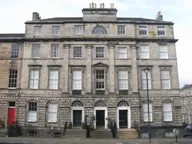
44, 46 and 48 Great King Street, Edinburgh New Town: Georgian terrace elevation with basement area, railings and sash and case windows
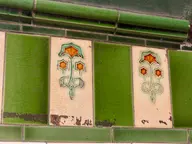
Art Nouveau glazed wall tiling of a Glasgow tenement close ('wally close'), Battlefield Road
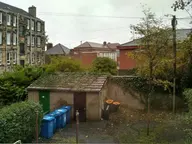
Back court behind Glasgow tenements, with communal bin store, drying poles and the rear gable of a sandstone tenement showing cast-iron downpipes
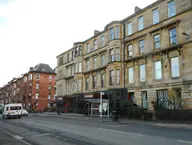
Blonde and red sandstone tenements with bay windows on Sauchiehall Street, Glasgow
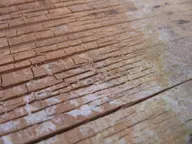
Close macro of cuboidal cracking on a Douglas fir board, with white mycelium threading through the cracks
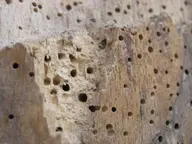
Close-up of a broken block of beech riddled with 1 to 1.5mm round woodworm exit holes, with pale frass in the broken face
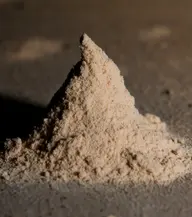
Conical pile of pale gritty bore dust (frass) produced by woodworm larvae, about 5cm high
CC0 1.0 (attribution not required, credited anyway)
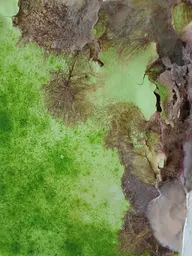
Coniophora puteana (cellar fungus): fine dark brown-black branching strands fanning across a painted wall, with algal growth from persistent damp
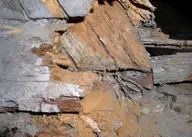
Cuboidal brown rot cracking in the destroyed foot of a roof truss, with Serpula lacrymans mycelial cords beneath the tenon
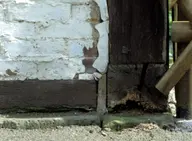
Decayed timber-frame sill beam and post foot where the frame meets the masonry plinth of a barn
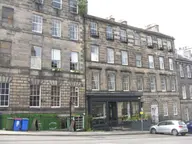
Edinburgh New Town tenements on Dublin Street, showing basement-level frontages below the pavement
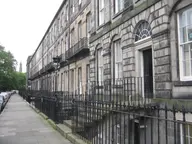
Houses on Fettes Row, Edinburgh New Town, from the pavement: railings, steps to the main doors and steps down to basement flats
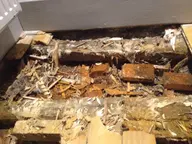
Lifted timber floor exposing destroyed joists, rubble and brick over a damp subfloor void
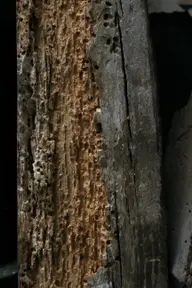
Oak joist in situ with the sapwood destroyed by wood-boring beetle attack, dense holes and galleries under raking light
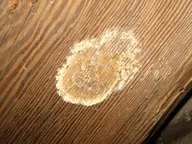
Older dried fruiting body of Coniophora puteana on a roof rafter
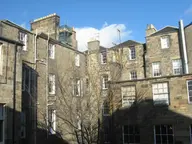
Rear elevation of Georgian tenements at Queen Street and Hanover Street, Edinburgh, with cast-iron rainwater downpipes running down the stone
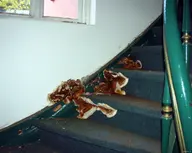
Serpula lacrymans fruiting bodies (brackets) erupting through a domestic staircase string and treads
Copyrighted free use (attribution not required, credited anyway)
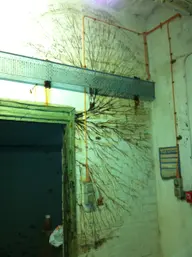
Serpula lacrymans mycelial cords (rhizomorphs) fanning out across a painted brick wall from a door frame
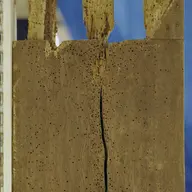
Structural oak timber densely covered in round beetle exit holes, in the interior of the Pieterskerk, Leiden
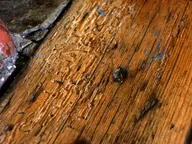
Woodworm holes and exposed larval burrows in the surface of a pine floorboard
Public domain (released by the author) (attribution not required, credited anyway)


If one of these is yours
If you took one of these photographs and something here is wrong, the credit is misspelled, the licence is misstated, or you would simply rather it was not used, get in touch through the enquiry form and it will be corrected or removed. That is not a grudging offer. Nobody is obliged to illustrate somebody else's trade site.
Looking to book a survey? Start here and we will point you at the team covering your postcode.