Woodworm
Woodworm treatment
Woodworm is beetle larvae eating their way through timber. The holes you have found are where the beetles left, which is why the first job is working out whether anything is still in there.
- Alive or long dead firstHalf of what we look at needs nothing
- Findings in writingWhich timbers, and what state they are in
- Central Belt onlyTwo teams, West and East
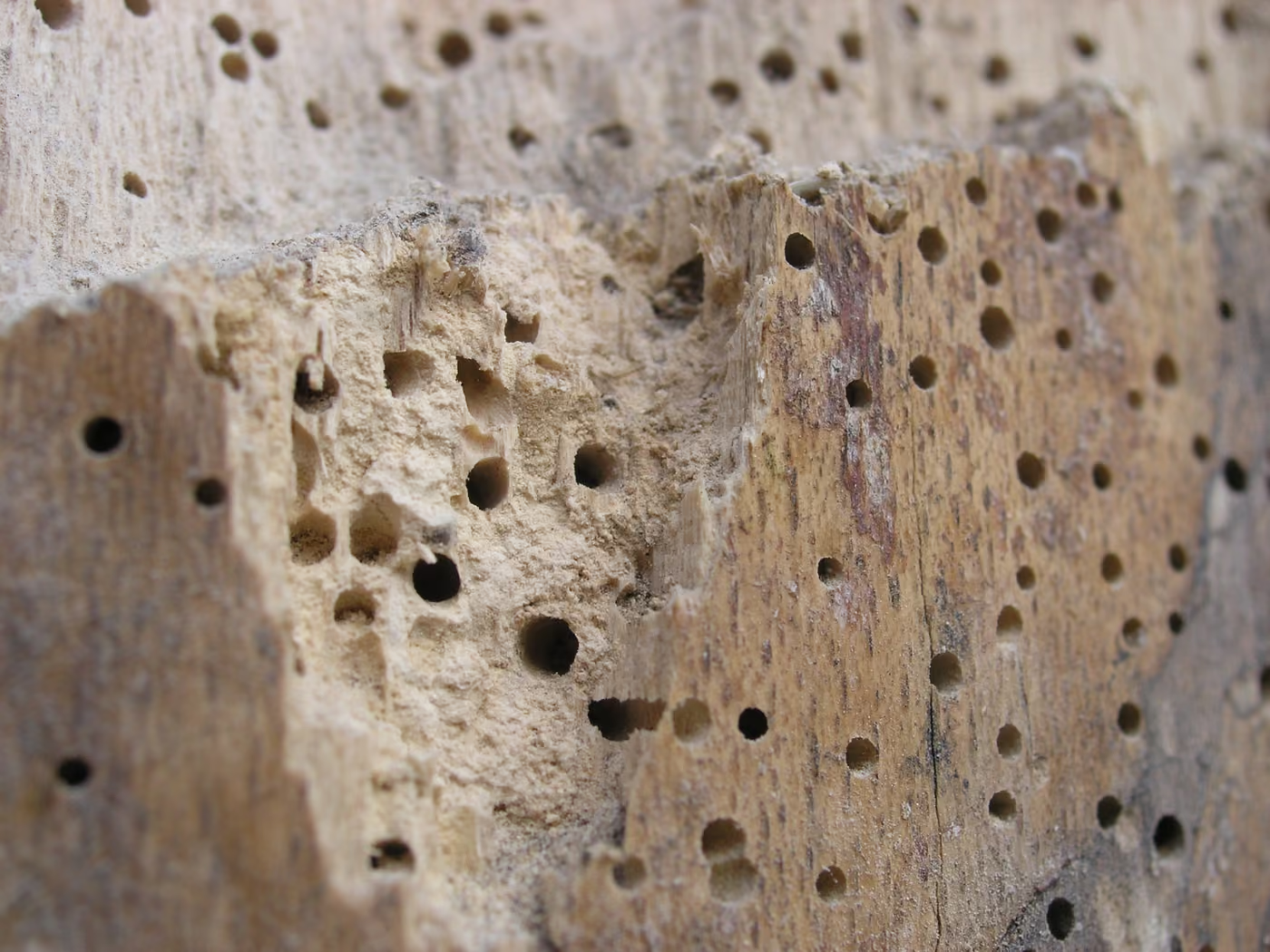

Woodworm is not a worm. It is the common name for the larvae of several wood boring beetles, and in Scottish houses it is nearly always the same one, the common furniture beetle, Anobium punctatum. The adult lays eggs in a crack or an open pore in the timber, the grub hatches and tunnels through the wood for anything from two to five years, then pupates near the surface and chews its way out as a beetle. The round hole you are looking at is that exit. It is the end of one larva's story, not evidence of what is happening today.
That single fact changes the whole conversation. The question is neverare there holes. It is is anything still alive in there. A very large share of what we get asked to look at is historic: old flight holes in floorboards, loft joists or the back of a wardrobe from an infestation that ran out of damp and stopped decades ago. Dead woodworm needs no treatment at all, and a contractor who sprays it anyway has sold you a job that was never there.
So this page is written in that order. What woodworm actually is, how to read the signs of woodworm in front of you, how to tell active from historic, and only then what treatment involves and what it costs. If you want the practical test first, there is a fuller walk-through of it inhow to tell if woodworm is active.
Book a survey
Three questions. You do not need to know which problem you have.
Where is the property?
We work as two teams. Pick the side of the country you are on and you will get the one that covers it.
The life cycle, and why the timing matters
Almost all of a woodworm's life is spent out of sight. The egg is laid on bare timber, usually in a crack, an old hole or the open grain at the end of a board, because the female cannot lay through paint or a hard varnish. The larva hatches and eats. It is in there, digesting the starchy sapwood, for two to five years depending on how warm and how damp the timber is. Only at the very end does it come up to just under the surface, pupate, and emerge as an adult beetle through a fresh hole.
Adults of the common furniture beetle emerge roughly between May and August. They live a couple of weeks, they mate, the female lays and the cycle starts again. Three things follow from that, and they are the practical reasons timing gets discussed at all.
- Summer is when activity announces itself. Fresh holes, new frass and beetles on the windowsill all belong to the emergence season. Inspecting in February tells you less, because nothing has come out for months.
- A surface treatment kills what crosses the surface. It deals with emerging adults, with eggs laid on treated timber and with larvae that hatch and try to bore in. It does not reach a grub already three years deep in a joist.
- Judging success takes more than a fortnight. Because the cycle runs over years, the honest measure of a treatment is whether new holes and fresh frass appear over the following two summers, not whether anything happens next week.
Signs of woodworm, and what woodworm looks like
Most people find woodworm in one of three places: a lifted floorboard, a loft, or a piece of old furniture. What you are looking for is a small cluster of signs rather than any one of them alone.
- Exit holes. Round, roughly 1 to 2mm across for the common furniture beetle, often in loose groups. Bigger holes mean a different beetle, which matters, and is covered further down.
- Frass. The bore dust pushed out as the adult leaves. It is fine, pale and gritty, closer to sieved sand than to household dust, and it collects in little cones below holes or on whatever sits underneath the timber.
- Tunnels in broken timber. If a board splits or you cut a piece back, active galleries are packed with that same pale dust. Old ones are usually clean, sometimes cobwebbed.
- Beetles. Small brown insects, a few millimetres long, on an interior windowsill in early summer. They fly towards light on their way out.
- Weak, crumbling edges. Where an infestation has run for a long time in damp timber, the surface goes soft and a bradawl or a penknife sinks in with almost no pressure.
What does woodworm look like itself? Almost nobody sees it. The larva is a creamy white grub curled into a tight C, a few millimetres long, and it stays inside the wood for its whole life. If you have found a grub in the open, it has almost certainly come out of timber that has just been broken or cut.
Active or historic, and how to tell
This is the part worth taking your time over, because it decides whether you spend anything at all.
Colour and edge. A fresh exit hole is pale inside, the same colour as clean timber, with a sharp edge and no dirt in it. An old hole in an unpolished, undusted place goes grey and grubby, and the edge rounds off. On a waxed or polished piece of furniture the old holes fill with polish, which is a good sign of age, and the fresh ones do not.
The frass test. Brush or hoover every trace of dust away, put clean paper or a white sheet under the timber, and leave it. If pale dust reappears, particularly in the summer months, something is still working in there. This is the single most useful thing a homeowner can do, it costs nothing, and it is worth doing before anybody is asked to quote.
Damp. Common furniture beetle strongly prefers timber that is a bit wet, above roughly 12 per cent moisture content. Timber in a heated room that has been dry for thirty years is a poor home for it. Timber in an unventilated Scottish floor void, over ground with no through draught because the airbricks are behind a flowerbed or a later extension, is a very good one. So the moisture reading a surveyor takes is not a side note, it is part of the diagnosis.
A great deal of woodworm needs nothing done to it. Old holes in a joist that is dry, sound and still doing its job are a record of something that has already stopped. Nobody enjoys writing that on a report they could have charged for, but a firm that cannot tell you when the answer is "leave it alone" is not a firm whose warnings mean anything.
What woodworm treatment actually involves
When treatment genuinely is called for, the work has three parts, and only one of them is chemical.
- Fix the reason it is thriving. Nearly always damp. A leaking waste pipe under a bath, a blocked airbrick, a cracked hopper running down a gable, a cellar with no ventilation. Treating the timber and leaving the water is how people end up paying twice.
- Expose and prepare the timber. Chemicals do nothing through paint, varnish, old bitumen or a thick layer of dust, and nothing at all through a floor covering. That means lifting boards or at least enough of them to get access, clearing the void, and brushing or hoovering the surfaces first.
- Apply the treatment. Usually a water based permethrin insecticide, or a boron based product, sprayed or brushed onto the exposed timber. Both are low odour and both work by making the surface layer lethal to anything crossing it. In heavier cases a paste or gel is applied to joist ends, or holes are drilled and an injectable used, to get the product deeper into a large section.
- Check it over the following seasons. New frass or clean new holes the summer after treatment mean the job is not finished. That is also the point of getting the extent written down beforehand, so there is a record of what was treated.
Permethrin and boron are both perfectly ordinary products. Boron is often preferred where timber is damp, because it moves into wet wood well. What neither of them does is any of the following, and this is where quotes and reality part company.
What spraying does not do
A surface spray is a barrier. It kills eggs and emerging adults, and larvae that hatch on treated wood and try to enter. It does not sterilise the inside of a joist, and it does not reach a larva already deep in the section. That is not a criticism of the product, it is simply what a surface applied treatment is.
More importantly, spray restores nothing. If beetles have been in a joist end for twenty years in damp conditions and taken out a good part of the sapwood, the timber is weaker than it was, and no chemical puts that back. Timber that has lost strength has to be replaced, doubled up or supported. Any quote that answers a genuinely weakened floor with a spray and a guarantee certificate is answering the wrong question, and the certificate is the part being sold.
This is why a proper woodworm specialist spends most of the visit with a bradawl and a torch rather than a sprayer. The chemical decision is easy. The structural one is the reason somebody has to come and look.
When timber is replaced or strengthened instead
You are into repair rather than treatment when any of these are true.
- A bradawl or screwdriver pushes into the timber with little resistance across a real depth, not just a soft skin.
- The damage is at a joist end built into a solid sandstone wall, which in Scottish tenement construction has no cavity and no damp proof course between the masonry and the timber. Joist ends are where damp and beetle damage meet, and where the load actually sits.
- The floor feels springy, a board line has dropped, or a skirting has pulled away from the wall.
- There is rot as well. Woodworm and wet rot keep the same company, because both want the same damp. Where you find both, the rot usually sets the scope of the repair.
The usual repairs are cutting back to sound timber and splicing in new, bolting a new joist alongside the old one, which is called sistering, or resting the cut ends on a new bearer or joist hanger so they are no longer buried in wet masonry. All of it is ordinary carpentry. It is priced separately from treatment, and it is the main reason two quotes for the same flat can look nothing like each other. There is a fuller breakdown on thewoodworm treatment cost page.
Deathwatch beetle, the exception
Nearly everything above assumes common furniture beetle, because it is almost always what you have. The one identification that genuinely changes the job is deathwatch beetle, Xestobium rufovillosum. It goes for old hardwood, oak above all, and usually hardwood that has already been damp and partly decayed. Its exit holes are larger, around 3mm, and the frass is coarser and more bun shaped than the fine dust of furniture beetle.
It matters because deathwatch beetle turns up in exactly the timbers you least want it in: old oak beams, lintels and roof structures in period and listed property, often deep sections that a surface spray barely troubles. Treatment tends to involve pastes and injection rather than a spray alone, it is closely tied to drying the timber out, and it takes patience because the life cycle can run much longer than the furniture beetle's. If the holes you are looking at are noticeably bigger than a pinhead and the timber is old oak, say so when you book, because it changes what the surveyor brings and how long they need.
When it is honestly a DIY job
Not everything here needs a contractor, and pretending otherwise would be the fastest way to lose your trust.
Small surface woodworm in furniture is a DIY job. A chair, a chest of drawers, a wardrobe back, a single skirting board or a small patch of accessible loft timber, all of it can be dealt with by a tin of woodworm fluid from any builders merchant, a brush, gloves, a mask and an afternoon. Do it outside or in a well ventilated room, get the product into the holes and the end grain rather than just wiping the face, and keep the piece somewhere dry afterwards. That is the whole job. If somebody quotes you three figures to treat a bedside table, you are being sold a call-out.
It stops being a DIY job at a fairly clear line. Bring somebody in when the timber is structural, such as floor joists, roof timbers, lintels or stair strings. Bring somebody in when you cannot see the extent, which in practice means anything under a floor or behind lath and plaster. Bring somebody in when there is damp you have not traced, when there is rot as well, or when a lender, a surveyor or a home report has asked for a specialist timber report in writing, because your own good work in a loft will not satisfy that.
Why Scottish property sees so much of it
Woodworm follows damp, and the Central Belt building stock supplies plenty. Tenement floors are suspended timber over voids that were never well ventilated to begin with, and a century of flowerbeds, decking, driveways and back extensions has closed off a lot of the airbricks that were doing the work. Joist ends sit in solid sandstone with nothing between timber and masonry. Shared gutters, downpipes and hoppers belong to every flat in the close and therefore in practice to nobody, so a split hopper can wet the same run of wall for years. Add long wet autumns and a lot of lath and plaster and you get exactly the conditions the common furniture beetle likes.
It also explains the pattern we see most: not a house-wide plague, but one damp corner. A bathroom floor, the joists over a cellar, the bottom of a stair, timber against a gable that takes the weather. Deal with the water, treat or replace what needs it, and the rest of the floor is usually fine.
Getting it looked at
A survey is a look before a price, not a sales visit with a clipboard. A surveyor should be lifting a board, taking moisture readings, testing timber with a bradawl and telling you plainly whether what you have is live or historic. You should get that in writing whether or not you have any work done. What that visit involves, and when it is not worth paying for, is set out on the woodworm survey page.
Questions people ask
How do I know if woodworm is still active?
Look for holes with clean, pale, sharp edges rather than dark grey ones, and for frass, a fine gritty dust like sieved sand, sitting fresh below the holes or on the timber underneath. Frass that reappears within a week or two of being brushed away is the strongest sign you have of live larvae. Adults emerge roughly May to August, so late spring and summer are when activity shows itself most clearly.
What does woodworm look like?
You almost never see the woodworm itself. The larva is a small creamy white grub, curled into a C shape, and it stays inside the timber for years. What you see is the round exit hole the adult beetle made on its way out, about 1 to 2mm across for the common furniture beetle, and sometimes the beetle itself, a brown insect a few millimetres long, on a windowsill in summer.
Does woodworm spread from one room to another?
Adult beetles fly, so yes, an active infestation can spread to other timber in the same building, and they tend to favour damp softwood and the sapwood at the edge of a joist. It is far slower than people fear, though. The reason woodworm keeps going in a Scottish tenement floor void is usually damp rather than the beetles being unstoppable, which is why drying the void out matters as much as any chemical.
Do I need to move out during woodworm treatment?
For most surface treatments you need to stay out of the treated rooms while the spray dries and the space is ventilated, commonly for several hours to a day, and fish tanks, birds and small pets need moving out entirely. The team doing the work will give you the exact re-entry period for the product they use. Larger jobs involving lifted floors and timber replacement are more disruptive than the chemical itself.
Can I treat woodworm myself?
For a piece of furniture, a joist you can reach, or a small patch of loft timber, yes. A tin of woodworm fluid from a builders merchant and a careful afternoon is a genuine fix for a small surface infestation. Where it stops being a DIY job is when the affected timber is structural, when you cannot see how far it runs, or when the reason the beetles are thriving is damp you have not found yet.
Is woodworm covered by buildings insurance?
Almost never. Insurers treat woodworm and rot as maintenance and gradual deterioration rather than a sudden insured event, so the cost normally falls on the owner. The exception worth checking is where the damp that allowed it came from something insured, such as an escape of water, in which case the resulting timber damage may fall inside the claim.
Book a survey
Three questions. You do not need to know which problem you have.