Woodworm
Woodworm treatment cost
What the work usually costs in Scotland, what moves a quote up and down, and why anybody who gives you a firm figure without seeing the property is guessing.
- Looked at before it is pricedNobody can quote this from a photo
- Itemised, not one lump sumTreatment and joinery priced apart
- Central Belt onlyTwo teams, West and East
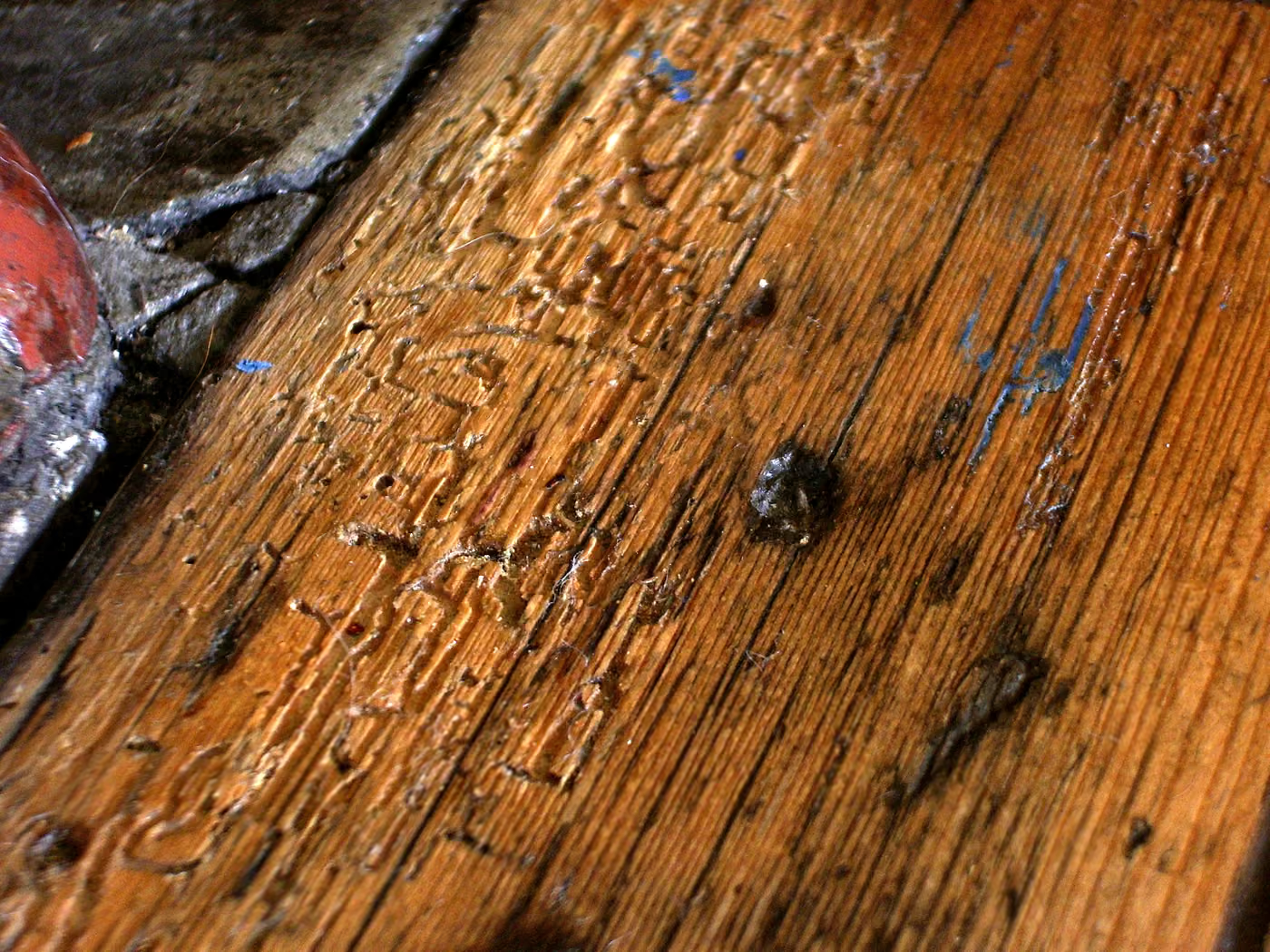

The short version is that most woodworm work in Scotland falls somewhere between a few hundred pounds and a few thousand, and where in that gap you land has far more to do with joinery and access than with the chemical. A surface treatment in one room is a modest job. The same treatment becomes an expensive one when the floor has to come up, two joist ends have gone soft in a wet gable and somebody has to put it all back afterwards.
The ranges below are what work of this kind typically lands in for Central Belt property in 2026. They are not a quote, and they cannot be. Nobody, including us, can price timber work accurately without looking at the timber, because the visible holes tell you where an infestation surfaced, not how far it runs or what state the wood underneath is in.
Book a survey
Three questions. You do not need to know which problem you have.
| Work | Typical range | What moves it |
|---|---|---|
| One room, surface treatment | £300 to £700 | A bedroom or hall floor, or a small run of loft timber. Rises if the floor covering has to come up and go back. |
| A small flat throughout | £600 to £1,500 | One or two bedroom flat, timber exposed and treated. Access, stair carries and clearing the void move it. |
| Whole house, floors lifted | £1,500 to £4,000 | Lifting and relaying boards across several rooms, plus loft timbers. The upper end assumes some repair work. |
| Joist end replacement, per joist | £150 to £400 | Cutting back to sound timber and splicing or sistering in new. Depends on span, access and whether the end is built into masonry. |
| Chargeable survey | £150 to £350 | A written report for a lender, a home report query or a purchase. Often refunded against the work if you go ahead. |
These are the ranges work of this kind usually lands in, not a quote. Prices assume normal domestic access and exclude fixing the damp that caused the problem, which is priced on what is actually leaking.
What actually drives the price
Six things move a woodworm quote, and only one of them is the treatment itself.
The area of timber being treated
Treatment is priced by the area of exposed timber, so a hall and a bedroom cost roughly twice one of them. This is the part of the bill that behaves predictably. It is also usually the smaller part.
Access, which is the real variable
Getting to the timber is where the hours go. A cleared loft with a fixed ladder is a different job from a loft full of forty years of belongings reached through a hatch over a stairwell. A bare floorboarded room is a different job from one carpeted, then laminated, then furnished. If you are in a tenement, everything has to be carried up and down a common stair, which adds time on every trip, and if the close has a shared entry that has to be kept clear and secure, that adds more.
Whether floors have to come up
This is the single biggest step change in price. Treating what can be seen from a hatch is cheap. Lifting a floor properly, board by board so that most of them can go back down, is slow work, and tongue and groove boards or later chipboard sheets over the original timber make it slower. Then it has to be relaid, which is a second lot of labour. A quote that involves lifting floors should say how much of the floor, and what happens to boards that break.
Whether joists need replacing or sistering
Chemicals do not restore strength. Where beetle damage has been running in damp timber for years, the answer is carpentry: cutting back to sound wood and splicing in new, bolting a fresh joist alongside the old one, or getting a buried joist end out of wet masonry and onto a hanger or bearer. Priced per joist this is not dramatic, but it multiplies quickly across a floor, and a job that turns out to need six joist ends done is in a different price bracket from one that needs none.
Scaffold, towers and working at height
Most woodworm work is internal and needs no scaffold at all. It appears when the damp feeding the beetles is coming from outside and has to be fixed first: a hopper, a downpipe joint, a lead flashing, a dormer cheek, a stone skew. Scaffold or a tower is then hired for that repair rather than for the treatment, and on a tenement gable it can be a significant line on its own. It is worth asking whether it is included, excluded or provisional, because it is one of the commonest sources of a quote growing after acceptance.
Flats, closes and shared responsibility
A flat in a close brings its own arithmetic. Access to a back court or a common stair may need arranging with neighbours. If the water causing the problem is coming through a shared roof, gutter or downpipe, the repair belongs to every owner in the block under Scottish tenement law, and the honest answer is that agreeing a common repair takes longer than the work does. A contractor can only price what is inside your own boundary, so a quote for your floor may sit alongside a share of a common repair you still have to organise.
What a quote should itemise
A single figure on a compliment slip is not a quote. Anything you are asked to sign should separate out at least the following, so that you can compare two firms line by line and see where they disagree.
- Which rooms and which timbers are being treated, by name, not "the property".
- The product being used and the method, whether that is spray, brush, paste or injection.
- Preparation and access as their own line: lifting boards, clearing voids, moving furniture, carpet up and back.
- Any timber replacement, priced per joist or per metre, with a stated allowance if the full extent is not yet known.
- Making good, and exactly what that includes. Relaying boards is not the same as restoring a floor finish.
- The damp repair, or a clear statement that it is excluded and who is doing it.
- What the guarantee covers, how long it runs and whether it depends on the damp work being completed.
- VAT, stated as included or not, and the payment stages.
Two things should not be on it. A charge for treating timber the surveyor has told you is historic and sound, and an open-ended "extras as required" with no rate attached to it.
When a survey is chargeable and when it is not
Both exist, and they are different products, so it is worth knowing which one you are asking for.
A quotation visit is normally free. Somebody comes out, looks, and gives you a price for work they hope to do. It is paid for out of the jobs that go ahead. What it is not is an independent opinion, because the person forming it is also the person selling the remedy.
A written report is normally chargeable, commonly in the 150 to 350 pound range. You are paying for the surveyor's time and their name on a document that a third party will read: a mortgage lender who has asked for a specialist timber report, a solicitor, a buyer negotiating after a home report flagged timber, or you deciding whether to proceed at all. Many firms refund the fee against the work if you go ahead with them, which is worth confirming in advance rather than assuming.
If a report is what a lender wants, do not accept a free quotation sheet in its place. Lenders and their surveyors are looking for a document that states what was inspected, what was found, what was not accessible and what is recommended. A price list will not close that query and you will end up paying for the report anyway, later, under time pressure.
The cheapest option is often the right one, and sometimes it is nothing. If the holes are grey, the frass never comes back and the timber is dry and firm, the correct spend is zero, and the second cheapest is a couple of hundred pounds for a report that says so in writing. A tin of woodworm fluid from a merchant, for a wardrobe or a single skirting, costs less than a takeaway and does the job properly. We would rather tell you that than sell you a house treatment you did not need, because the pages that concede nothing are the ones nobody believes.
Why quotes for the same flat differ so much
Homeowners often assume a spread between quotes means somebody is overcharging. Occasionally that is true. Far more often the two firms have priced genuinely different jobs.
- One has priced treating what is visible. The other has priced opening up to find out what is not.
- One has assumed the boards can be lifted and relaid. The other has allowed for replacing a proportion of them.
- One has included the damp repair. The other has excluded it, sometimes in a line you have to look for.
- One is quoting a guarantee that depends on the damp work being done by them, which is a different commercial offer, not just a different price.
The fix is to get all quotes itemised in the same shape and to compare them line by line. If one is missing a line the others have, that is not a saving, it is a cost that has not been named yet.
What is not included in a treatment price
Assume these are separate unless the quote says otherwise. Fixing the leak, the hopper, the airbrick or the failed flashing that made the timber attractive in the first place. Structural repair beyond the joist work listed. Redecoration, floor finishes, skirting replacement and carpet refitting. Electrical or plumbing work disturbed by lifting a floor, which is a real cost in older Scottish flats where cables and pipes run through notched joists. Any common repair shared with the other owners in a close.
Getting an accurate figure for your property
Everything above is a starting point for a conversation, not a price. The only way to get a real number is for somebody to see the timber, take moisture readings, test the wood with a bradawl and tell you what state it is in. What that visit involves is set out on thewoodworm survey page, and the biology behind the decision is on thewoodworm treatment page. Before you book anything, it is worth spending ten minutes onhow to tell if woodworm is active, because the cheapest quote of all is the one you never need to ask for.
Questions people ask
How much does woodworm treatment cost for one room?
A single room surface treatment in Scotland typically runs between about 300 and 700 pounds in 2026, assuming the timber can be exposed without much difficulty. That covers preparation, the treatment itself and the paperwork. It does not cover replacing weakened timber, relaying a floor covering or fixing the damp that let the beetles thrive, all of which are priced separately.
Why is one quote double another for the same flat?
Almost always because the two firms have scoped different work, not because one is greedy. One may have priced spraying accessible timber while the other has priced lifting the whole floor, replacing two joist ends and dealing with the damp underneath. Ask both to itemise. Once you can see treatment, joinery, access and making good as separate lines, the difference usually explains itself.
Is a woodworm survey free?
A survey to price work is normally free, because the firm expects to quote for the job at the end of it. A survey that produces a written report for a mortgage lender, a home report query or a purchase negotiation is normally chargeable, commonly 150 to 350 pounds, and many firms refund that against the work if you go ahead with them. Ask which one you are getting before the visit.
Should I pay a deposit for woodworm treatment?
A deposit is reasonable on a job with materials or timber to order, but it should be a modest proportion of the total and it should be written down, along with what happens if the work does not start. Be wary of a large upfront payment on a job that is mostly labour, and of any pressure to pay in full before the work is finished and you have seen it.
Does treating woodworm add value when selling?
What helps at sale is the paperwork, not the spray. A written report saying the activity is historic and the timber is sound will settle a buyer surveyor question just as well as a treatment certificate, and costs far less. Where treatment does matter is when a lender has made a retention or made the loan conditional on the timber work being done.
Can I get woodworm treatment cheaper by doing the access myself?
Sometimes, yes, and it is worth asking. Clearing a loft, moving furniture, taking up carpet and laminate and emptying a cupboard under the stairs are all things you can do without a tradesman, and they are chargeable hours if somebody else does them. Lifting structural floorboards is different, because badly lifted boards get damaged and end up costing more to put back.
Book a survey
Three questions. You do not need to know which problem you have.