Dry rot
Dry rot treatment
Dry rot is the only rot that travels. It can push through masonry and reach dry timber several metres from the water that started it, which changes what a repair has to do.
- Extent found before pricingDry rot is always bigger than it looks
- The cause named in writingFix the water or it comes back
- No blanket sprayingChemical where it is needed, not everywhere
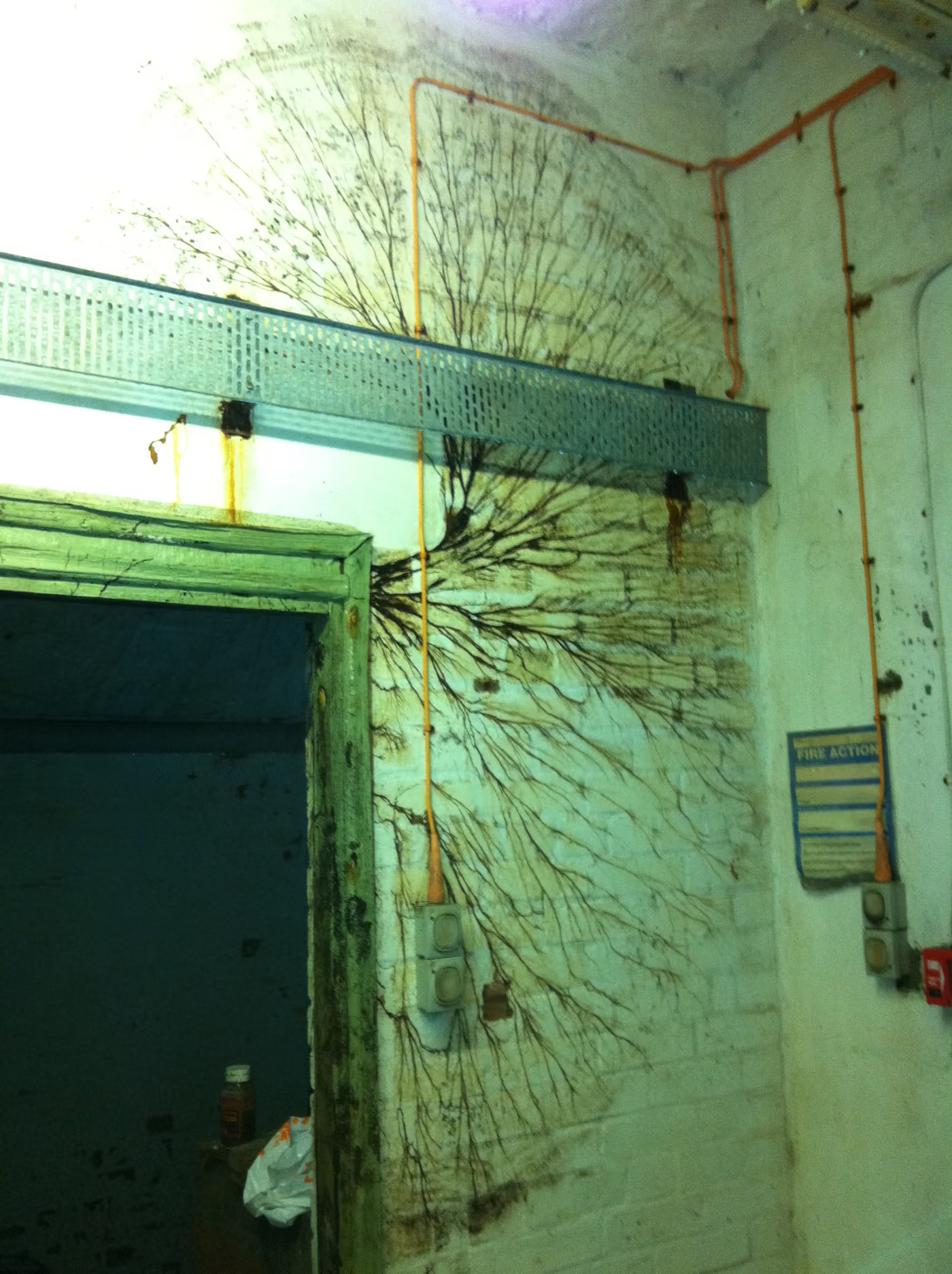

Dry rot is one fungus, Serpula lacrymans, and it does something nothing else that eats building timber does. Wet rot stays where the water is and dies back when the timber dries out. Dry rot starts in wet timber too, at somewhere around 20 per cent moisture content, but once it is established it grows strands that carry water for it. From that point it can push through and behind masonry, travel several metres from the leak that started it, and begin breaking down timber in a room where nothing has ever been wet.
That single fact drives everything else on this page. It is why the repair almost always reaches further than the damage you can see, why a firm price over the phone is a guess, and why treating dry rot as though it were wet rot leaves it working away quietly behind the new plaster.
The name misleads people. Dry rot does not begin in a dry building. It is called dry rot because of what it leaves behind: timber that is dry, light, dull brown and crumbling into cubes, long after the water that fed it has gone.
If you are trying to work out what you have, the smell and the strands tell you more than the damage does. Both are described below. If you would rather somebody settled it, a dry rot survey does that before you commit to any treatment, and it is also the only way to get a figure you can rely on.
Book a survey
Three questions. You do not need to know which problem you have.
Where is the property?
We work as two teams. Pick the side of the country you are on and you will get the one that covers it.
What does dry rot look like?
It looks like several different things depending on how far along it is, which is the main reason people walk past it. These are the signs of dry rot in roughly the order they appear.
- White or grey mycelium. A soft mat of fine white growth, like cotton wool or a thick cobweb, spreading over timber, plaster or bare masonry. In a still, damp space such as an unventilated floor void or a cellar it can look like a sheet of felt laid over everything. Where a little air reaches it, it flattens off and goes grey.
- Grey strands. Running out of the mat and away from it are strands that can reach the thickness of a pencil. These are the water pipes of the fungus, and they are the reason it can leave the damp behind. When they dry they snap rather than bend, which is a useful thing to know if you are poking at something with a screwdriver.
- A red-brown fruiting body. A flat, fleshy plate rather like a pancake, rust or brick coloured in the middle with a white or pale cream rim and a wrinkled, pored surface. It often appears on a wall or ceiling rather than on the timber being eaten, because the fungus fruits where it can release spores into the air.
- Rust-red spore dust. Fine reddish-brown dust settling on skirtings, window sills, the top of a door frame or the edge of a carpet. On white paint it is unmistakable, and it is very often the thing that finally makes somebody pick up the phone.
- Cuboidal cracking. The timber shrinks and splits both along and across the grain, breaking into brick-shaped cubes. It goes dull brown, feels far too light in the hand and crumbles under a thumbnail. Wet rot darkens and goes soft or stringy. Dry rot goes cubic and dry, and once you have seen the difference once you will not confuse them again.
The dry rot smell
There is a smell, and people describe it almost identically: damp mushrooms. Musty, earthy, faintly sweet, and strongest when you open a cupboard that has been shut for a while, lift a floor hatch or come back to a flat after a week away. It is not the flat, wet-plaster smell of general damp. If you keep noticing mushrooms in one room and can see nothing at all, that is worth taking seriously, because dry rot does most of its work out of sight, in a floor void, behind lath and plaster, under a stair or inside a boxed-in pipe run.
The signs that show up in the building rather than the timber
Long before anything visible appears, the structure starts behaving oddly. A floorboard near a wall goes springy underfoot. A skirting sounds hollow when you tap along it and gives when you press with a thumb. Paint blisters or a patch of plaster bulges and then dries out again. A door that always shut starts binding at one corner because the timber it is fixed to has moved. None of these prove dry rot on their own, and a fair number turn out to be damage that stopped moving long ago. They are simply the point at which it is worth looking properly rather than waiting to see what happens.
Why the repair almost always reaches further than the damage
With wet rot the boundary of the job is more or less the boundary of the soft timber, because the fungus cannot live in wood that is drying out. Dry rot has no such boundary. The strands can run behind plaster, through the mortar joints of a solid wall, around the back of a chimney breast and out into the next room, all without a single visible mark on the finished surface. By the time a fruiting body appears on a wall, the growth behind it is generally older and wider than the part you are looking at.
So the first job on site is not treatment, it is establishing extent. That means lifting boards, taking off a section of skirting, opening a small hole in plaster where the strands are heading, and taking moisture readings across a wide area rather than at the one obvious spot. It is intrusive and it is the only honest way to price the work. A quote produced without any of it is a quote for the part somebody could see, which is not the same thing as a quote for the problem.
What dry rot treatment actually involves
Modern practice is a sequence, and the order matters more than any product in it.
- Find and stop the water. Everything else is wasted until this is done. A cracked hopper, a slipped slate, a blocked gutter, a leaking waste pipe, a failed roof valley, rain driving into an exposed gable. Dry rot cannot establish itself in timber that stays dry, so the leak is not a preliminary to the treatment, it is the treatment.
- Open up and establish the extent. Boards up, a section of skirting off, and readings taken well beyond the visible growth so the boundary of the work is a measured thing rather than a guess.
- Cut back the affected timber. Decayed timber is removed along with a margin of sound timber past the last visible growth, typically a few hundred millimetres, then cut ends are treated. This is where quotes differ most, and where over-specification hides.
- Deal with the masonry, but only where it has gone into it.Where strands have crossed a wall, the plaster comes off over the affected area, the surface is cleaned back, and the wall may be irrigated with a fungicidal solution through drilled holes so the treatment reaches inside the thickness of the stone. On a solid sandstone wall this is sometimes genuinely necessary. On a wall the fungus never entered, it is money for nothing.
- Dry the structure. The building has to lose the moisture it has taken on, which means ventilation, time, and often a delay before new timber goes in. This is the stage people are most tempted to skip and the stage that decides whether the repair lasts.
- Replace and isolate. New pre-treated timber goes back, ideally kept out of direct contact with damp masonry using joist hangers, a damp proof membrane at bearings, or a ventilated detail. Isolating the new timber from the wall is worth more in the long run than any amount of chemical sprayed on it.
- Make good and re-inspect. Plaster, floor, decoration, and a look back later to confirm the readings have come down. A repair that is never checked is an assumption.
Why treatment is far less chemical than it used to be
If your parents had dry rot dealt with in the 1970s or 1980s, the job probably involved stripping plaster back well past any growth, drilling and irrigating whole walls as a matter of routine, and spraying entire floor voids whether or not the fungus had been near them. That approach came from a genuine belief that the fungus could not be beaten any other way, and from a trade selling long guarantees that were easier to underwrite if everything had been soaked.
Current thinking is different. Drying the building is understood to be the primary control, because Serpula lacrymans cannot survive in timber that is kept dry, and there is no product that beats removing its water supply. Chemical treatment still has a real place, mainly at cut ends, on retained timber close to the outbreak, and in masonry the strands have actually entered. But it is targeted now, the volumes are far smaller, and the environmental and occupancy considerations are taken seriously in a way they simply were not forty years ago.
Being honest about it: some firms still specify the old way. If a quote lists wholesale plaster removal, wall irrigation across rooms where nothing has been found, and a blanket spray of every joist in the property, you are looking at a specification written to be sold rather than one written from what was found. Ask which specific findings justify each item. A dry rot specialist worth paying will answer that without getting defensive, and will usually have the moisture readings to hand.
Caught early, this can be a much smaller job than you fear.If the water came from something obvious that has already been fixed, the growth is confined to one joist end or a patch of floor, and there is no sign of strands heading into the wall, the work can genuinely be a day or two: cut back, treat the cut ends, splice or replace the timber, make good. People arrive at this page braced for a five-figure bill, and a fair proportion of them do not need one. The reason we open up before quoting is as much to rule that out as to rule it in.
Why Scottish buildings get this more than most
The building stock does most of the work. In a sandstone tenement the floor joists are built directly into solid masonry, with no cavity and usually no damp proof course, so the joist end sits inside the wall itself. Anything that wets that wall wets the timber, and the joist end is the one part of the floor nobody can see. It is where a large share of dry rot in Scotland starts.
Above that sit shared roofs, gutters, downpipes and hoppers, which under tenement law belong to every owner in the building and therefore in practice often to nobody in particular. A cracked hopper at second floor level can run water down the same patch of stone for years while everyone assumes somebody else has it in hand. Add long wet autumns, high rainfall in the west, cellars and sunk basements with almost no through draught, and lath and plaster that holds moisture against the wall, and you have the conditions this trade exists to deal with.
It also means the cause is frequently outside the flat with the problem, and sometimes outside the building. Fixing dry rot in a top floor flat can require a conversation with the owners below about a shared downpipe, which is frustrating and is also the only route to a repair that holds.
Choosing somebody to do the work
Three questions separate a considered specification from a template. What did you actually find, and where. Which of these items follows from which finding. And what happens about the water, because if that is not in the quote the rest of it is decoration. You are entitled to see the moisture readings and to have the extent explained in terms of what was opened up rather than what was assumed.
It is also reasonable to get a second opinion on any substantial outbreak. The variation between quotes for the same dry rot is wider than in almost any other building trade, and the range is set less by materials than by how much of the building each firm proposes to take apart. Our page ondry rot treatment cost sets out where that money goes, andtelling wet rot from dry rot is worth reading first if you are not yet certain which of the two you are dealing with, because a good share of what gets quoted as dry rot is wet rot with a frightening name attached.
Questions people ask
Can dry rot really spread through a wall?
Yes, and it is the only timber decay fungus in a British building that does. Serpula lacrymans grows water-conducting strands that let it cross masonry, plaster and even the back of a chimney breast to reach dry timber some distance from the original damp. That is why a repair confined to the visible rot so often fails.
What does dry rot smell like?
Damp mushrooms. Musty, earthy and slightly sweet, and usually strongest when you open a cupboard that has been shut, lift a floor hatch or walk back into a flat after a few days away. It is a different smell from general damp, which is flatter and more like wet plaster.
Will dry rot stop on its own if I fix the leak?
Fixing the water is the single most important thing you can do and it will halt the spread, because the fungus cannot expand into timber it cannot keep wet. It will not repair the timber that has already gone, and dormant growth in masonry can restart if the wall gets wet again, so drying the structure is the start of the job rather than the whole of it.
Do I have to replace all the timber the fungus touched?
No. The usual approach is to cut back sound timber a sensible distance past the last visible growth and replace only what has lost strength. Removing every board a strand has crossed is a common way for a quote to double without making the repair any more durable.
Is dry rot treatment worse than wet rot treatment?
Usually, yes, because wet rot stays where the damp is and dies when the timber dries, so the repair stops where the soft timber stops. Dry rot needs the wall and the surrounding structure investigated as well, which is why the same size of visible patch can cost several times more to put right.
How long does the work take?
A small localised outbreak with one joist end is often a few days including making good. A floor that has to come up, be irrigated where it meets masonry and then dry out before new timber goes in can run over several weeks, most of which is drying time rather than labour.
Book a survey
Three questions. You do not need to know which problem you have.