Wet rot
Wet rot treatment
The commoner of the two rots, and usually the cheaper one to put right. It lives where the water is, so most of the work is finding the water and stopping it.
- Extent found before pricingSoft timber goes further than it shows
- Written up either wayWhat is rotten and what wet it
- Central Belt onlyTwo teams, West and East
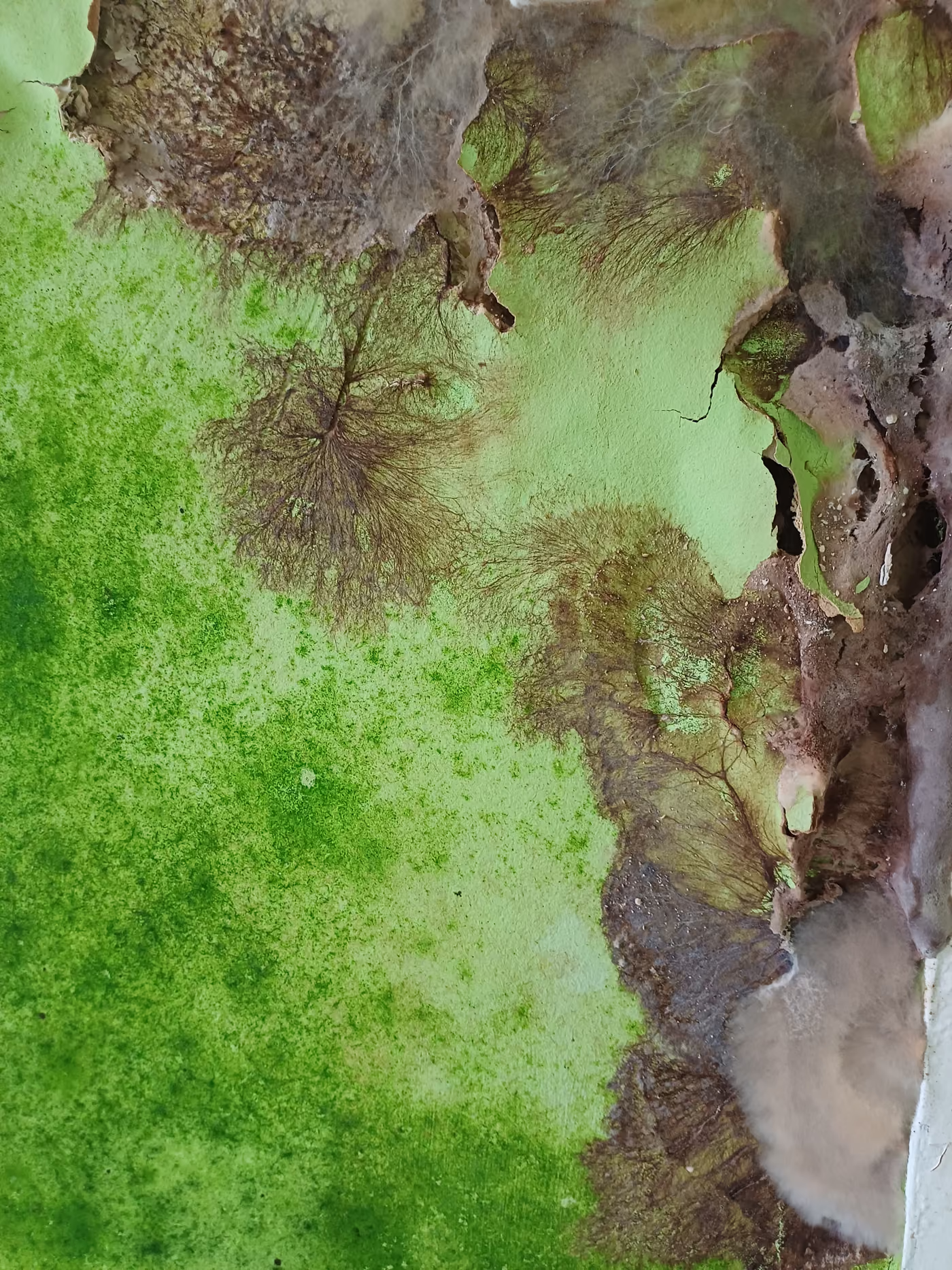

Wet rot is timber decay caused by a fungus that needs the wood to be wet to live in it. In most Scottish houses the fungus doing the damage isConiophora puteana, the cellar fungus. The single most useful thing to understand about it is also the thing that makes it different from dry rot: it stays where the water is, and it dies when the timber dries out.
That one fact decides almost everything about the job. Wet rot does not travel through masonry hunting for fresh timber. It does not carry its own water along strands into a dry part of the building. It sits in the wet patch, eats the timber in the wet patch, and stops at the edge of the wet patch. So the repair is usually contained, usually smaller than people fear when they first press a screwdriver into a soft sill, and usually cheaper than the equivalent dry rot job.
Wet rot treatment is therefore four things in a fixed order. Find and fix the water. Let the timber dry. Cut out and replace whatever has lost structural strength. Treat and protect the sound timber that stays. Skip the first step and the other three are money spent on a repair that will rot again, usually within a few years and usually in the same spot.
Book a survey
Three questions. You do not need to know which problem you have.
Where is the property?
We work as two teams. Pick the side of the country you are on and you will get the one that covers it.
What wet rot is, and what it is doing to the timber
Wet rot is a general name for several fungi that break down damp timber. Coniophora puteana is the one you will meet most often, which is why it gets called the cellar fungus, but the same soft dark decay can be caused by a handful of related species and the treatment does not change much between them. What they all have in common is a moisture requirement. The timber has to be genuinely wet, well above the moisture content of ordinary indoor joinery, before any of them can get going.
The fungus feeds on the parts of the wood that give it stiffness. That is why the damage is structural rather than cosmetic even when the surface still looks like wood. A joist end with wet rot in it can hold paint, hold its shape and hold a nail, and still have lost a large share of the strength it had when it was built in. This is the reason nobody sensible quotes wet rot from a photograph. What matters is not what the surface looks like, it is how far back the softness goes.
Wet rot early signs, and what it feels like
Wet rot looks different depending on whether the timber is still wet or has since dried out, and people often miss it in the second state because it no longer looks damp.
While the timber is still wet, look for:
- Darkened timber. A patch noticeably browner or blacker than the wood around it, often with a clear edge where the damp stops.
- Soft and spongy under pressure. A screwdriver or a bradawl pushes in with little resistance, and the wood fibres come away stringy rather than in clean splinters.
- Paint holding on over nothing. Gloss on a sill or a door frame can bridge over decayed timber for a long time. A blistered or lifting line of paint is often the first visible sign.
- A musty smell. Strongest in a closed space such as a cupboard, a cellar or a boxed-in area under a stair.
Once the source of water has stopped and the timber has dried, it changes:
- Cracking along the grain. Long splits running the length of the timber rather than the cube-shaped cracking dry rot leaves.
- Shrunken and crumbly. The decayed section pulls back from the sound wood beside it and breaks up in the hand.
- Thin brown or black strands. Coniophora puteana can leave fine dark threads across the surface of timber or on nearby plaster. They are much finer than the grey ropes dry rot produces, and they do not carry water into dry timber.
Plenty of what we get called out to has already stopped.Dried, crumbly, cracked timber with no active damp in it is the wreckage of a leak somebody fixed years ago. It may still need replacing if it is holding something up, but it is not spreading and it is not an emergency. A moisture reading and ten minutes with a bradawl will usually settle which of the two you have, and that is worth knowing before you agree to anything.
Where wet rot turns up in Scottish property
Wet rot goes exactly where the water goes, so the places it appears are a map of where Scottish buildings let water in. High rainfall and long wet autumns mean external joinery here spends months of the year wet rather than damp, and a stone building holds that moisture against timber for far longer than a modern cavity wall would.
- Window sills and the bottoms of sash and case windows.The bottom rail of the lower sash, the sill itself and the ends of the box frame where it meets the stone. Water sits in that joint, paint cracks, and the rot works inward from the joint rather than from the face you can see.
- Joist ends built into solid masonry. Tenement and pre-war construction puts the end of a timber joist straight into a sandstone wall with no cavity and no damp proof course. Anything wetting that wall from outside, a cracked hopper, a blocked gutter, a slipped slate, wets the end of the joist, and that end is where the load sits.
- Suspended timber floors over damp voids. Ground floor flats and houses with a void under the boards rely on airbricks to keep that void ventilated. Once airbricks are blocked by a flowerbed, decking, a later extension or a rendered-over wall, humidity climbs and joists near the perimeter start to go.
- Under sinks, baths and shower trays. A slow waste leak that never shows on a ceiling is one of the most common causes of rot in a floor, because the water goes straight into the timber.
- Flat roof timbers and dormer cheeks. A failed felt or a tired dormer flashing keeps a deck wet for years, and by the time a stain appears inside, the deck and often the joists have gone.
- Cellar and basement joists. Low ventilation, cool surfaces and ground moisture make cellars the classic home of the cellar fungus, which is how it got the name.
- The bottoms of door frames. Especially external doors and close doors, where rain drives against the foot of the frame and the threshold detail has failed.
How to treat wet rot
The order matters more than any individual step, because every step after the first is wasted if the first one is skipped.
- Find the water and stop it. This is the actual job. Sometimes it is obvious, a leaking waste pipe or a gutter running down a wall. Sometimes it is a shared downpipe or hopper serving four flats, in which case fixing it is a conversation with the other owners before it is a repair. Until the water stops, nothing else is worth paying for.
- Open up enough to see the extent. Lift boards, take off the sill nosing, remove a section of skirting or lath and plaster. Wet rot is nearly always further back than the visible damage, because the wet part of the timber is bigger than the stained part.
- Let it dry. Timber that has been soaked for years does not dry in a weekend. Improving ventilation, clearing airbricks and leaving a floor open for a period is often part of the work rather than a delay to it.
- Cut out what has lost strength. Decayed timber is removed back to sound wood, with a margin, and replaced. On a joist that often means a new end spliced onto the existing joist and supported off a hanger or a plate rather than back into the wet wall pocket it came out of. On a window it may mean a new bottom rail or a new sill rather than a new window.
- Protect what stays. Sound timber that remains in a spot that has already rotted once, and any new timber going in, gets a preservative treatment. The point is to buy tolerance against the damp coming back, not to kill something that is already dying.
- Make good. Plaster, skirting, flooring, paint. On a lot of jobs this is a bigger share of the bill than the rot repair itself, which surprises people.
In a lot of cases no chemical treatment is needed at all.Some firms will spray wet rot as a matter of course because it is easy to put on a quote and hard for a homeowner to argue with. If the water is gone and the timber is drying, the fungus is already finished. A preservative on retained and replacement timber is sensible insurance. A whole-floor chemical treatment for wet rot usually is not, and you are entitled to ask what it is protecting against before you pay for it.
When you want a wet rot specialist rather than a joiner
A good joiner can replace a rotten sill perfectly well, and for a self-contained bit of external joinery that is often the right call. What a wet rot specialist adds is the diagnosis, and there are three situations where that is worth paying for.
- You do not know where the water is coming from. Replacing the timber without answering that question is buying the same repair twice.
- The timber is structural. Joists, beams, lintels, rafters and anything bearing into a wall. How far the decay runs into the wall pocket cannot be judged from the room side.
- You are not certain it is wet rot. If what you are looking at might be dry rot, the size of the job changes completely, and so does the order the work has to be done in. Our page ontelling wet rot and dry rot apart goes through the differences properly.
There is also the paperwork case. If a Scottish home report has flagged timber decay, or a lender has asked for a specialist timber report before releasing funds, a joiner's invoice will not satisfy them. They want the damage identified, the cause identified and the remedial work described. That is a wet rot survey, and it is a different piece of work from the repair.
What it costs, roughly
Wet rot is normally the cheapest of the three timber problems on this site to put right, because the affected area is contained. A single window sill repair is a few hundred pounds. A cellar or a large floor area runs into the low thousands. The variable that moves the number most is rarely the timber, it is the cause: a leaking waste trap is a cheap fix, a failing flat roof or shared rainwater goods across a tenement is not. Thewet rot treatment cost page sets out typical ranges and what pushes a job to the top of one.
What happens if you leave it
Wet rot will not race across the building, so leaving it is not the emergency that untreated dry rot is. What it does instead is quietly keep eating strength out of whatever it is in, for exactly as long as the water keeps arriving. A sill goes from a repair to a replacement. A joist end goes from a splice to a bounce in the floor and a crack in the ceiling below. And a wall kept permanently wet by the same fault is a wall where dry rot can eventually establish, which is a considerably more expensive problem. The argument for dealing with wet rot early is not panic, it is that the cost curve is steep and entirely avoidable.
Questions people ask
Does wet rot always need chemical treatment?
No. Wet rot needs high moisture to survive, so once the leak is fixed and the timber has dried out, the fungus dies on its own. A preservative is worth applying to sound timber that stays in place, and to new timber going into a spot that has already rotted once, but a house-wide chemical treatment for wet rot is rarely justified. If a quote is mostly spraying and hardly any joinery, ask what it is meant to achieve.
How do I tell wet rot from dry rot?
The short version is that wet rot stays where the water is and dry rot does not. Dry rot, Serpula lacrymans, is the only timber fungus in the UK that spreads through masonry to reach dry timber several metres away, and it leaves grey or white sheets of mycelium, rust-coloured spore dust and a musty mushroomy smell. Wet rot stays in the wet timber, darkens it and turns it soft and stringy. If there is any doubt, get it identified before anyone prices work, because the two jobs are not the same size.
What are the early signs of wet rot?
Paint that lifts or blisters on a window sill or door frame while the timber under it still looks intact, a musty smell in a cupboard or under a floor, a skirting that gives slightly when pressed, and staining or a dark patch in timber near a known leak. The most reliable early test is pressure. Sound timber resists a firm push with a small screwdriver or a bradawl. Timber with wet rot in it gives, and keeps giving.
How quickly does wet rot spread?
It spreads at the speed the water spreads, which is why a slow overflow under a bath can hollow out a joist end over a couple of winters without anything appearing in the room above. It will not travel across dry timber or through a wall the way dry rot can. That is the good news, and it is also why the date the leak started matters more than the date you noticed the damage.
Can I treat wet rot myself?
A few soft inches at the end of a window sill, where the rest of the sill is solid and the water has been stopped, is genuinely a weekend job with a chisel, a resin repair kit and a tin of preservative from a merchant. Anything structural is different. If the affected timber is a joist, a lintel, a beam bearing into a wall, or a rafter, it is holding something up, and how much of it is still sound is not something you can judge from the surface.
Will wet rot come back after treatment?
Only if the water does. Wet rot cannot sustain itself in dry timber, so a repair that fails is nearly always a sign that the leak was never found or was only partly fixed. If the same sill or the same joist end has rotted twice, the second repair is not the problem, the water is.
Book a survey
Three questions. You do not need to know which problem you have.